

Spring Ant Control in Sherman Oaks, CA | Bugs A to Z
Spring Ant Control in Sherman Oaks, CA | Bugs A to Z
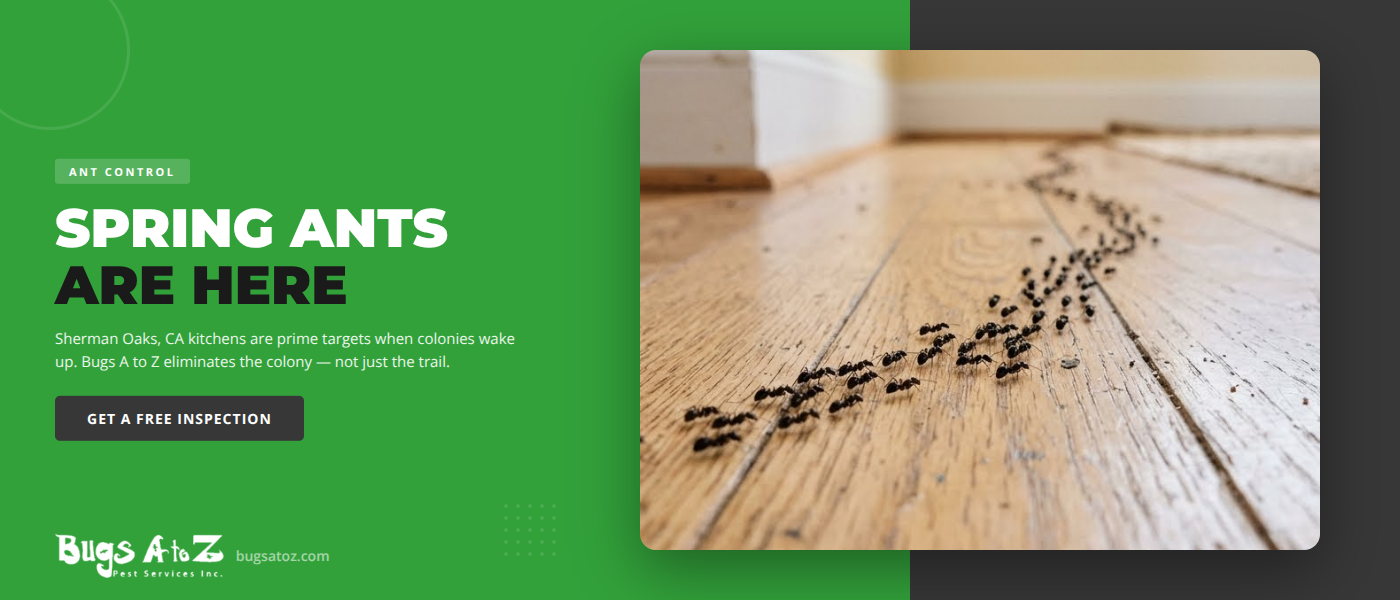
Spring is when most Sherman Oaks homeowners first notice them — a thin line of ants across the kitchen counter, behind the dish soap, along the baseboard near the pet food bowl. By the time that trail is visible, a colony has already located a food source, mapped a route, and started shuttling workers in steady traffic. Ant control in Sherman Oaks, CA gets dramatically easier when we step in early in the season instead of after a kitchen has been overrun.
At Bugs A to Z, we serve Sherman Oaks along with the rest of the San Fernando Valley, and spring is our busiest stretch for ant calls. Argentine ant colonies wake up, drought-stressed yards push foragers indoors, and kitchens become reliable food and water hubs overnight. This guide covers why spring drives the surge, the species we see most often, what tips a trail into a real infestation, what works at the homeowner level, and when to bring our team in.
Why Spring Brings More Ants Into Sherman Oaks, CA Homes
Argentine ants — by far the dominant species across the San Fernando Valley — spend the cool, rainy months tucked into protected outdoor sites: under landscape rock, beneath mulch and pavers, inside soil voids near foundations and irrigation lines. As soil temperatures climb through March and April, queens lay heavily and worker numbers in established supercolonies multiply.
According to the UC Statewide IPM Program, Argentine ant abundance climbs sharply through late winter and spring, peaks in midsummer, and stays elevated into early fall. That ramp-up is the moment when colonies need more food and water than the warming yards around them can supply, and foragers start probing every crack and gap for steady resources. A well-watered Sherman Oaks landscape with a kitchen twenty feet behind the back door is the kind of resource map a colony is built to exploit.
Spring also brings the first real spike in indoor food activity — windows opening, kids snacking on patios, BBQs running, pet bowls left out longer. Every change registers as a forager opportunity.
The Most Common Ant Species Invading San Fernando Valley Kitchens
The San Fernando Valley sees several pest ant species, but a small group dominates indoor calls in Sherman Oaks:
- Argentine ant (Linepithema humile) — behind the vast majority of trailing-ant calls we run. Roughly one-eighth inch, dull brown, follows narrow continuous trails. Supercolonies can connect across multiple yards on a block.
- Odorous house ant (Tapinoma sessile) — slightly darker, gives off a sharp coconut-like smell when crushed. Often nests in wall voids, under sinks, and around heated indoor equipment.
- Pavement ant — common around driveways and patio slabs; creeps indoors through expansion joints.
- Carpenter ant — much larger (a quarter to half an inch), black or red-and-black. Less common in Sherman Oaks, but they nest in moist or damaged wood and can compromise structural framing if ignored.
The vast majority of spring kitchen calls in Sherman Oaks come down to Argentine ants. Knowing the species matters because the right bait, placement, and colony approach all change with it. Spraying a counter-trail does little — the colony reroutes within hours and the underlying nest is unaffected.
How SoCal Drought and Irrigation Patterns Drive Ants Indoors
Sherman Oaks sits at the southern edge of the San Fernando Valley, with mature landscaping and heavily irrigated yards. UC IPM research highlights that Argentine ants flourish in well-irrigated urban gardens — exactly the conditions that define most Valley properties.
Multi-year drought adds a second pressure. When yards beyond the irrigation footprint dry out, foraging ants concentrate where water still flows: drip lines, leaky hose bibbs, condensation under HVAC units, pool deck seams, and irrigated turf perimeters. A kitchen sink, dishwasher line, or refrigerator drip pan reads to a thirsty colony as a small, reliable oasis.
That dynamic explains why neighbors a few blocks apart have very different ant pressure. A hillside Sherman Oaks lot with native landscaping often sees scattered foragers; a flat lot with daily lawn watering and ornamental beds along the foundation can host multiple intersecting Argentine trails by mid-April.
Signs Ant Activity Is Becoming a Full Infestation
A few stray ants on a windowsill is normal in spring across the Valley. The point at which we treat ant activity as an active infestation rather than nuisance scouting is when several of these signals show up together:
- A continuous trail — two-way ant traffic on the same path for hours or days means a colony has located a food or water source and is exploiting it.
- Multiple entry points — trails coming in under the window, around the sliding door track, and from an outlet on the same wall point to a colony that has mapped the structure.
- Indoor nesting evidence — fine debris near baseboards, activity concentrated under sinks or behind appliances, or workers carrying brood (small white capsules) suggest the colony is moving fragments inside.
- Activity at night — Argentine ants forage around the clock when conditions are right; visible trails at midnight mean the population is well past nuisance level.
- Trails ignoring small interruptions — if wiping a trail with a soapy cloth only reroutes the column, the source is large and committed.
Catching these signs early is the difference between a single targeted treatment and an extended program. Once a supercolony has bridged into a Sherman Oaks structure, a few household sprays will not move it back out.
DIY Ant Prevention Steps That Actually Work
Homeowners can do real, useful work to lower ant pressure on their own property. The steps below cost very little, and they are the same ones we recommend to every Sherman Oaks client at the start of the season.
Seal Visible Exterior Gaps
Walk the foundation, weep holes, the line where stucco meets framing, and gaps around utility penetrations. Caulk or screen openings larger than a quarter-inch. UC IPM recommends sealing entry points before peak activity, not after a trail is established.
Trim Vegetation Off the Structure
Branches, vines, and ornamental shrubs touching siding give ants a direct bridge over your foundation defenses. Pull plantings back at least six inches from the wall.
Manage Moisture Around the Home
Repair leaking spigots, fix dripping irrigation lines, and pull mulch back from the foundation. Cut the water and many trails stop on their own.
Tighten the Kitchen Routine
Wipe counters daily, store pet food in sealed containers, rinse recyclable cans before they leave the kitchen, and pull the trash any night the bin smells sweet.
Use Targeted Exterior Bait Early
Slow-acting Argentine ant baits placed along outdoor trails in March or early April — never sprayed, never disturbed — let foragers carry the active ingredient back to the nest. Baits and contact sprays do not mix, which is why we cover that next.
Walk the Perimeter Weekly
A five-minute spring walk-around catches early trails before the colony commits. Watch corners of the home, hose bibbs, and any spot where a planting bed meets the slab.
These steps reduce pressure noticeably. They do not, by themselves, eliminate an established supercolony — but they give a professional treatment a far better baseline to work from.
Why Store-Bought Sprays Often Make Ant Problems Worse
The instinct on seeing a kitchen trail is almost always the same: spray it. For Argentine ants, contact insecticide aerosols are one of the worst tools to reach for.
Argentine colonies spread risk by splitting. When part of a trail is killed by a contact spray, surviving foragers retreat and the colony fragments into satellite groups that establish new nesting sites — often closer to the spray, not farther away. UC IPM cautions that repellent products and aggressive disturbance can cause Argentine colonies to bud into multiple colonies, making the problem larger.
Sprays also shut down baiting. Slow-acting bait depends on healthy worker traffic to travel back to the queen. Spray that line and surviving workers will not touch the bait; the queens never see it, and reproduction continues uninterrupted in concealed nests behind the wall or under the slab.
The right approach is the opposite of what the can on the shelf suggests: leave trails alone for a few days, place targeted bait along the route, and let the colony carry the active ingredient home. For homeowners who cannot live with visible trails through that period, bringing our team in is the cleaner path.
When to Call Bugs A to Z for Professional Ant Control
Some ant situations are better handled by our team from the first sighting. Reach out to us when any of the following describes your Sherman Oaks property:
- Multiple intersecting trails inside the home — a sign of a large, committed colony rather than a single curious forager.
- Repeat ant pressure year after year in the same rooms — supercolonies do not relocate on their own, and properties with annual problems need a structured program.
- Carpenter ants of any size, anywhere — even a few large black ants indoors warrant a professional inspection for moisture damage and structural nesting.
- Activity inside electrical equipment or appliances — Argentine ants in HVAC units, dishwashers, or panel boxes can short components and need careful, targeted handling.
- Households with infants, elderly residents, or anyone managing food allergies — kitchen contamination is not worth a DIY learning curve.
Our spring program for ant control in Sherman Oaks, CA starts with a property walk to identify trails, nesting sites, and the moisture and food drivers tied to them. We apply a non-repellent treatment plan paired with targeted baits, and follow up to confirm colonies are collapsing rather than budding. Many Sherman Oaks customers fold ant control into our broader residential pest control program for year-round coverage.
We serve Sherman Oaks along with Encino, Tarzana, Studio City, Van Nuys, Woodland Hills, and the rest of the San Fernando Valley. To schedule a spring property inspection, reach our team through our contact page. Spring is the most efficient window of the year — a well-timed treatment now prevents the much bigger summer problem.
Frequently Asked Questions About Spring Ant Control in Sherman Oaks
When does ant season start in Sherman Oaks, CA?
Argentine ants begin ramping up in late February and March as soil temperatures climb. Indoor activity typically becomes obvious in April, peaks through July and August, and stays elevated into early fall. The most efficient window for prevention is March through May, before colonies fully expand and supercolonies bridge into homes.
Why are ants in my Sherman Oaks kitchen this spring if my house is clean?
Spring foragers are searching for water and any consistent food cue, no matter how small. Pet food, a dishwasher gasket, condensation under a sink, or a single drop of spilled soda is enough to draw a trail. Cleanliness reduces pressure, but a Sherman Oaks kitchen with normal water use is rarely invisible to a determined colony.
What kind of ants are most common in Sherman Oaks homes?
The Argentine ant is the dominant species across the San Fernando Valley by a wide margin. More than four out of every five indoor spring calls in Sherman Oaks involve Argentine ants.
Is it worth using store-bought ant spray on a kitchen trail?
For a small, isolated trail tied to a one-time spill, a soapy wipe-down plus sealing the entry point is usually enough. For sustained or repeating trails, household aerosols often make the problem worse by splitting the colony and shutting down any bait that follows.
How long does professional ant control take to work?
Most properly placed bait programs reduce visible trail activity within seven to fourteen days, with full colony collapse over the next several weeks. We adjust placements and follow-ups based on what we observe each visit.
Are your ant treatments designed with families and pets in mind?
Yes. Our technicians follow all label instructions, place baits where pets and children cannot reach them, and walk through the products and methods used at each visit.